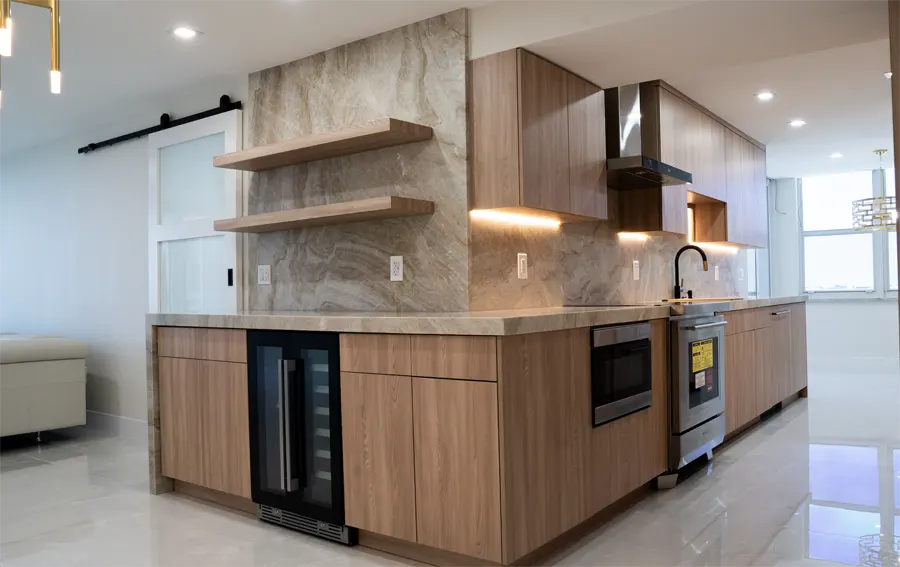
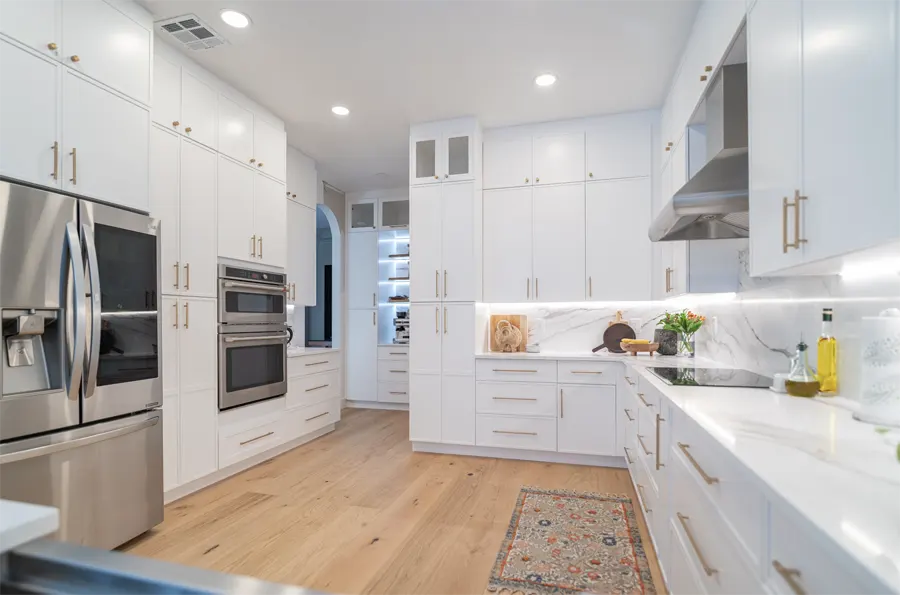
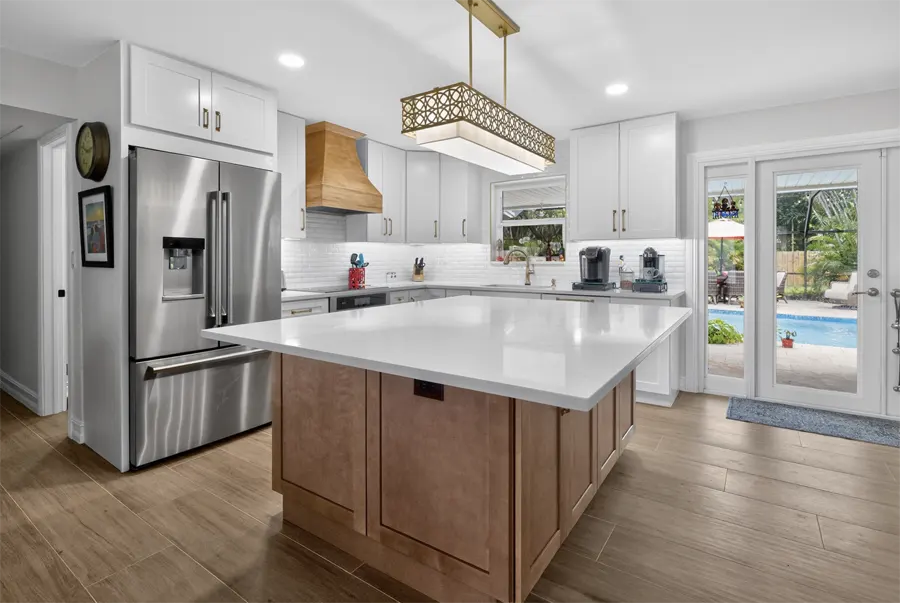
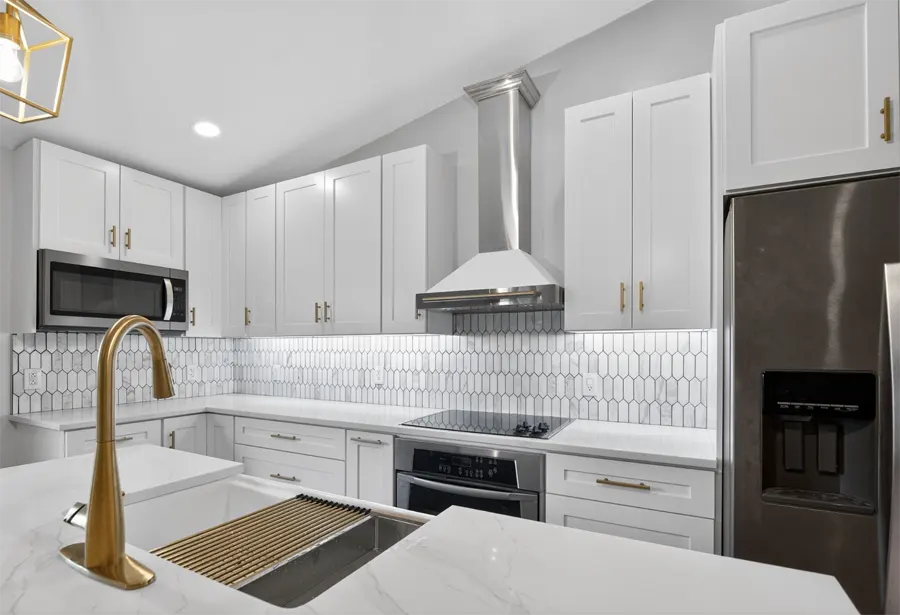
A Miami kitchen lives a harder life than almost anywhere else in the country. Eight months of humidity above 70%. Salt drift that finds bay-facing homes ten miles inland. Hurricane-season pressure swings that warp panel doors built for the Midwest. The right kitchen in Miami isn't the most expensive one — it's the one specified for the climate, permitted under the code, and installed by people who've seen what fails at year five.
What "kitchen remodeling" actually means in Miami-Dade
The phrase covers everything from a cosmetic cabinet refresh on an existing footprint to a full structural rework with new electrical service, re-routed plumbing, and a load-bearing wall removed. The cost difference between those two scopes is roughly twelve-fold, which is why "kitchen remodel cost" is one of the most misleading search terms on the internet. A useful conversation about budget starts only after a senior PM walks the room, measures the existing layout, and learns how you actually cook, host, and store.
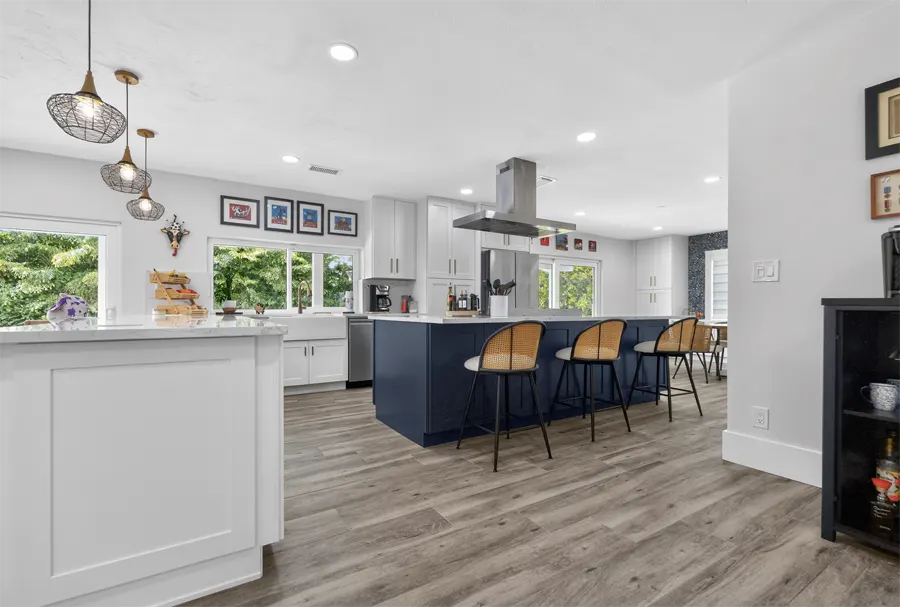
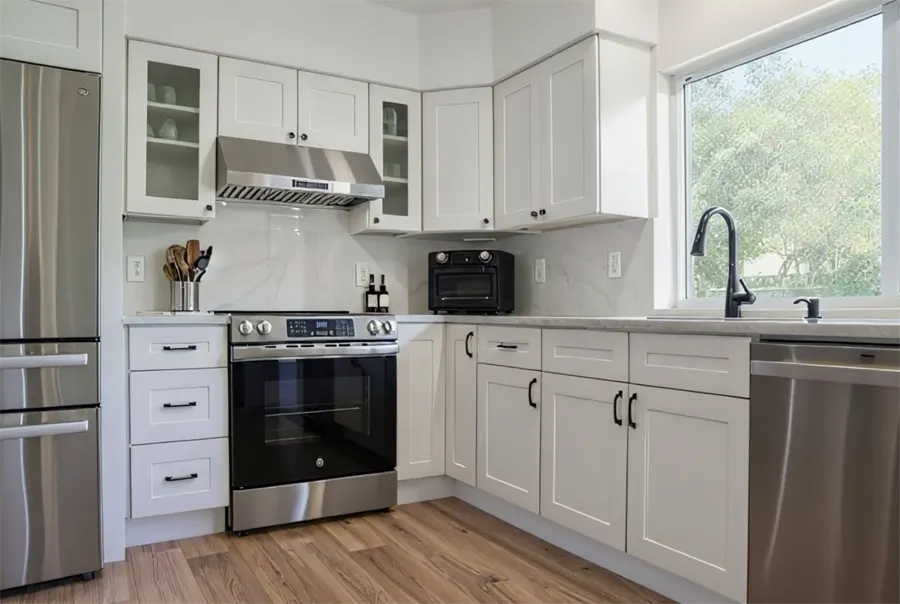
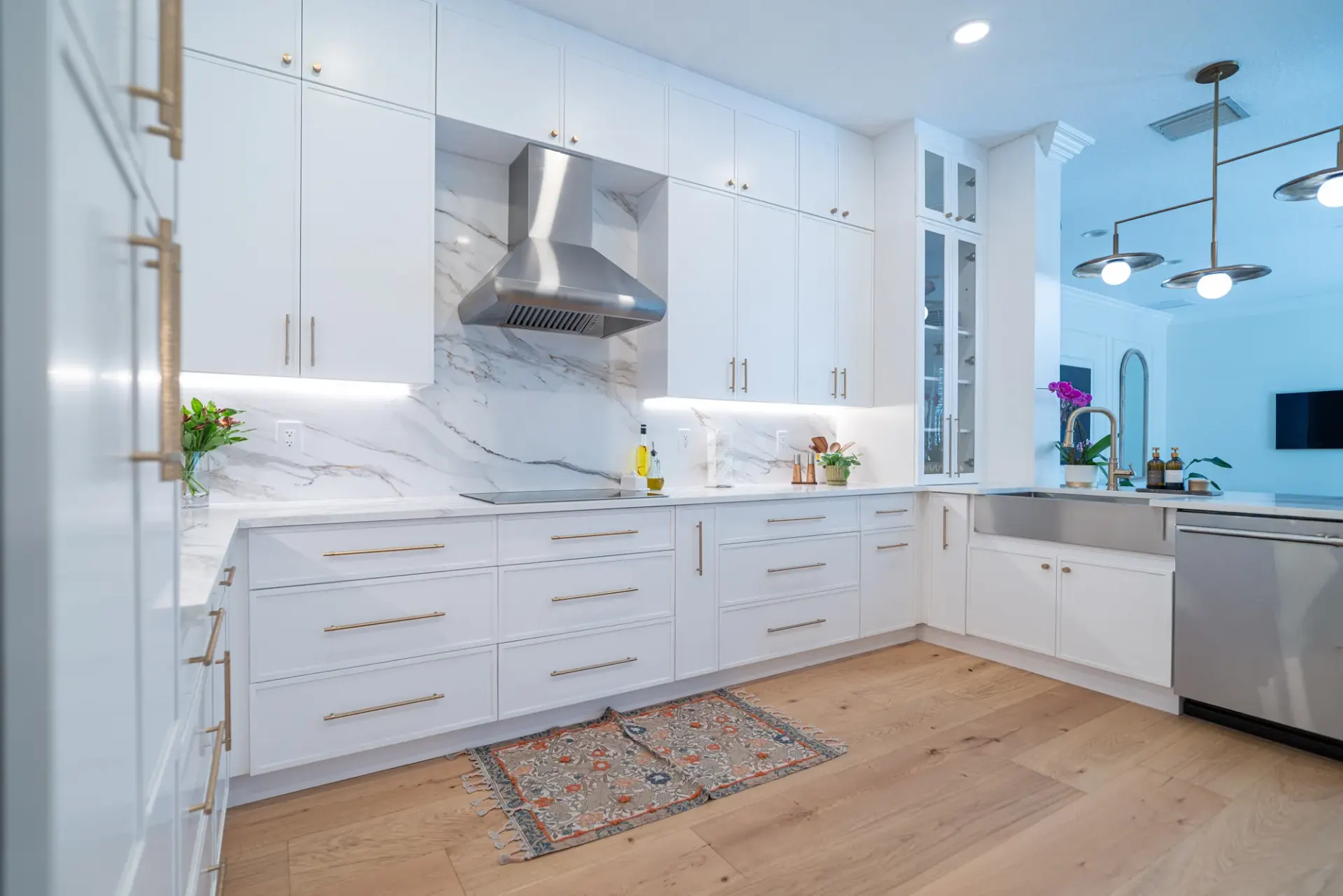
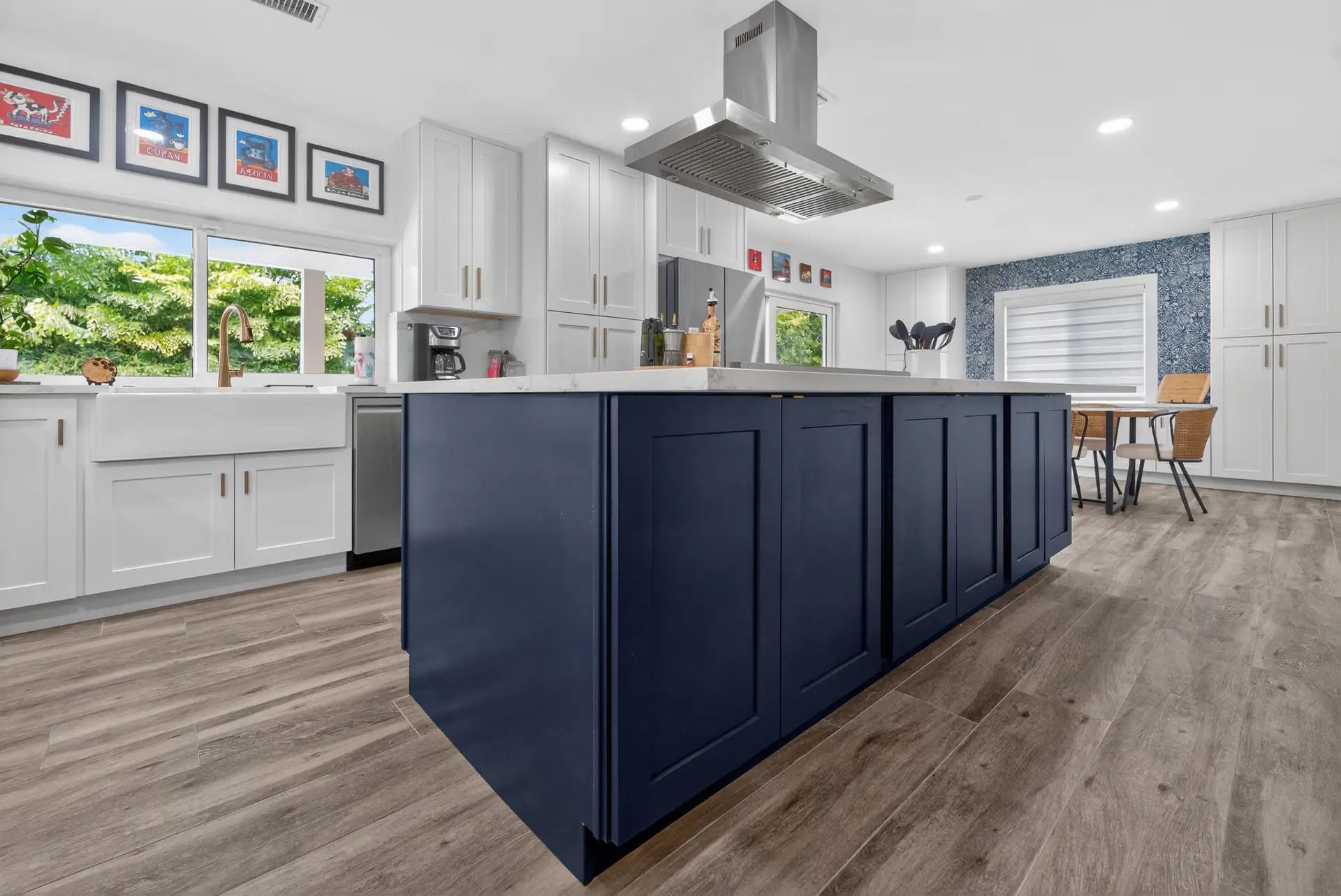
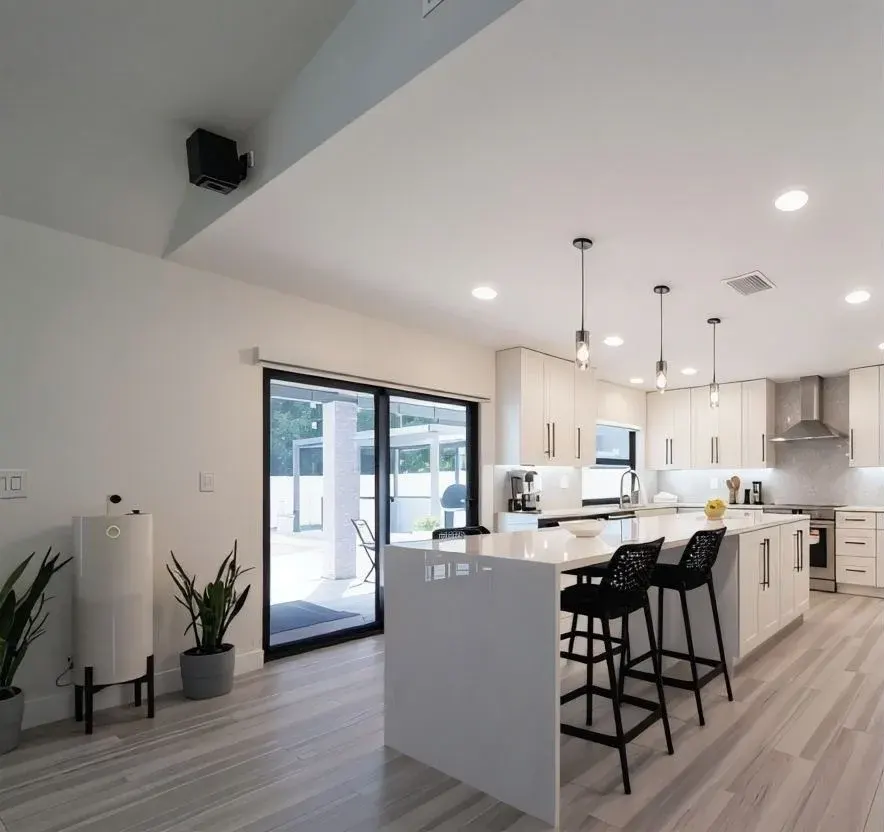
Most of what we build sits between the two extremes. The typical Miami First kitchen is a refined, 160–280 sq ft cook-and-host space where the existing footprint stays mostly intact but every surface, fixture, and circuit is new. Cabinetry is plywood-box, semi-custom or full-custom. Counters are a 3 cm slab. Plumbing and electrical are re-routed to match the new layout, pulled and inspected under our license. Eight to fourteen weeks on site once the permit is issued.
That tier — what we call "Refined" — accounts for roughly two-thirds of the kitchens we deliver. The contracts land between $110k and $180k for a typical 160 sq ft floor plan. The lower end gets you semi-custom cabinets, a Level-2 quartz counter, and the existing layout retained. The upper end gets you full-custom cabinets in inset or full-overlay, a quartzite or honed-marble slab with a mitered waterfall, and a layout reworked around how you actually use the room.
Why Miami climate changes the materials list
A kitchen built to a national-average spec will look fine on install day and start failing somewhere in years three through five. The first thing to go is hardware: zinc-alloy pulls and unplated steel hinges develop a chalky bloom from salt-laden air, even ten miles from the coast. We specify solid brass, solid bronze, or PVD-finished stainless on every kitchen, regardless of tier. The price difference at install is under $400. The price of replacing 40 pulls in year five is $2,800 plus the labor to drill them out.
The second thing to fail is panel doors built in dry climates. A solid-wood door manufactured in North Carolina at 40% relative humidity will arrive in Miami, sit in a 70%+ environment for the rest of its life, and swell. Mitered corners open. Center panels crack. We build cabinets locally — at our own shop in Dania Beach — under shop humidity that matches the homes they'll live in. The doors leave acclimatized.
The third thing — less visible but more expensive — is the substrate behind tile. National-spec wall board fails fast in Miami-Dade wet zones. We waterproof to current Miami-Dade code in every wet zone, including behind the range and around the sink: Schluter-KERDI or a polyurethane liquid membrane, inspected before tile goes up. It's a $1,200 line item that prevents a $40,000 mold remediation.
Cabinetry: semi-custom vs. full-custom
Semi-custom means cabinet boxes built to standard sizes (typically 3-inch increments) and finished to your spec. The box construction, drawer slides, hinges, and finish are all chosen by you; the dimensions come from a catalog. For most Miami kitchens this is the right answer. The catalog covers 95% of layouts, the lead time is shorter (5–7 weeks vs. 9–12), and the price is roughly 30% lower than full-custom.
Full-custom means every box is built to your exact dimensions, with door styles, profiles, and inlays that aren't in any catalog. This is the right answer when your room has odd angles, structural posts that need wrapping, or a design language that requires non-standard cabinet faces (inset doors with hand-applied beading, brass-and-walnut inlay, curved end panels). It's also the right answer when you're chasing a specific designer aesthetic that catalog millwork can't hit.
On both, the box itself should be plywood — not MDF, not particleboard. Plywood holds screws under load, survives a leaked-sink event, and lasts thirty years. Particleboard boxes fail in five. The price difference is roughly $1,500–$2,500 on a typical kitchen. Always plywood.
Counters: the slab decision
The right counter for your kitchen depends on three things: how you cook, how you feel about patina, and how much you're willing to maintain. Quartz (engineered) is bulletproof, non-porous, and looks the same in year ten as year one. Quartzite (natural) is harder than granite, etch-resistant, and has a depth that engineered surfaces can't replicate, but costs 50–80% more. Marble is the most beautiful and the highest-maintenance — it will etch from lemon juice and acidic wine, and the right buyer of a marble counter loves the patina that develops over years. Soapstone is the dark-horse pick for serious cooks: extremely heat-resistant, develops a soft patina, and forgives every kind of abuse.
We template every counter on-site, after cabinets are installed and scribed to the walls. This is the only way to get a clean fit on Miami homes, where 90-degree corners are rare and walls drift a half-inch over a 12-foot run. The slab cut happens at the fabricator's CNC, with the templates and the slab walked through together by our PM and the fabrication lead. Approve the cut before the saw drops. This is one of two project moments where we ask you to physically come look — the other is the lighting walk-through at the rough-electrical stage.
Permits, inspections, and what "licensed" actually means
Every kitchen we build is permitted under license CGC1530409, regardless of scope. This includes kitchens where the homeowner has been told by an unlicensed contractor that "you don't need a permit for cabinetry" — a statement that is technically true and operationally a disaster. The moment you re-route a single plumbing line, add a circuit for an induction range, or relocate a hood vent, the work requires a permit in Miami-Dade County. Doing it without one means your homeowner's insurance can deny a claim five years later when the unpermitted electrical causes a fire.
A properly permitted kitchen includes plan review, rough plumbing inspection, rough electrical inspection, drywall inspection, and a final certificate of completion in the homeowner's name. We pull all five. The final CC sits in your closing folder if you ever sell the house, and any future buyer's title search will pull it. Unpermitted kitchens become a $15,000–$30,000 closing problem when the buyer's lender flags them.
Timelines and what blows them up
A typical refined kitchen is 8–14 weeks on site once the permit is issued. The on-site clock starts at demo and ends at the final inspection. Before the on-site clock starts, you have 6–9 weeks of design, ordering, and permitting. End-to-end, plan to be 4–5 months from "yes, go" to hand-off.
The most common cause of a kitchen running late is appliance delays. Sub-Zero, Wolf, and Miele have all had 8–16 week lead times in 2024–2026 depending on the model. We confirm appliances are in-stock at our trade partner before we issue the build calendar. The second most common cause is design indecision: a client changes their slab selection in week 5, which pushes the templating date, which pushes the install date, which pushes the inspection. We allow two revision rounds in the contract; after that, changes are priced as a written change order with a new completion date.
The third cause is something you can't plan for — an unforeseen condition behind the walls. In a 1950s Miami home, demo can reveal anything from cast-iron drain stacks that need replacing to knob-and-tube electrical that needs a full re-pull. We carry a 7% contingency line item in every contract for exactly this. It rolls back to you if it isn't spent.
Resale value and the only honest number on ROI
Industry surveys routinely claim kitchen remodels return 60–80% of their cost at resale. This number is roughly true and almost useless. The right way to think about a kitchen is that you live in it for ten years, and the right kitchen makes the difference between selling your home in two weeks and selling it in seven months. In a Miami market with rising inventory through 2025–2026, kitchen condition is among the top three buyer dealbreakers — alongside roof age and impact-rated openings. A well-built kitchen doesn't "return" a dollar amount; it removes the line item from the buyer's negotiation list.
Working with a contractor: what to look for
License first. Every legitimate general contractor in Florida has a CGC or CRC number. Look it up at MyFloridaLicense.com — type in the license, see the company history, see any disciplinary actions. Then ask for the certificate of liability insurance, listed to your address and the work scope. Then ask for three references from kitchens delivered in the last 18 months. Call them.
On the contract itself, the single most important clause is fixed price vs. cost-plus. Cost-plus contracts (the contractor charges actual costs plus a 15–25% management fee) are appropriate for projects where the scope is genuinely undefined. A kitchen with a clear design and a clear scope should always be a fixed-price contract. The contractor takes the risk of cost overruns; you take the certainty of knowing what you're spending. Every Miami First kitchen contract is fixed-price.
Finally: meet the project manager. Not the salesperson, not the owner, the PM who will be on your site three days a week for three months. If the company won't introduce them before contract signing, that's information.
Neighborhoods we work in most
The majority of our kitchen work sits in Coral Gables, Pinecrest, Coconut Grove, Bay Harbor Islands, Brickell, South Beach, Doral, and Aventura. Each neighborhood has its own permit office, its own HOA culture, and its own typical home vintage — a 1932 Spanish revival in Coral Gables presents very different problems than a 2014 condo in Brickell. We have project managers who specialize in each. When you submit your scope, you'll be routed to the PM who has built the most kitchens in your specific neighborhood.
We also work in Hollywood, Fort Lauderdale, Boca Raton, Wellington, and Palm Beach Gardens when the project is large enough to justify the travel — typically $200k+ for kitchens, or whole-home work that includes a kitchen. For smaller projects outside Miami-Dade, we'll refer you to a trusted local builder rather than over-promise on logistics we can't deliver.